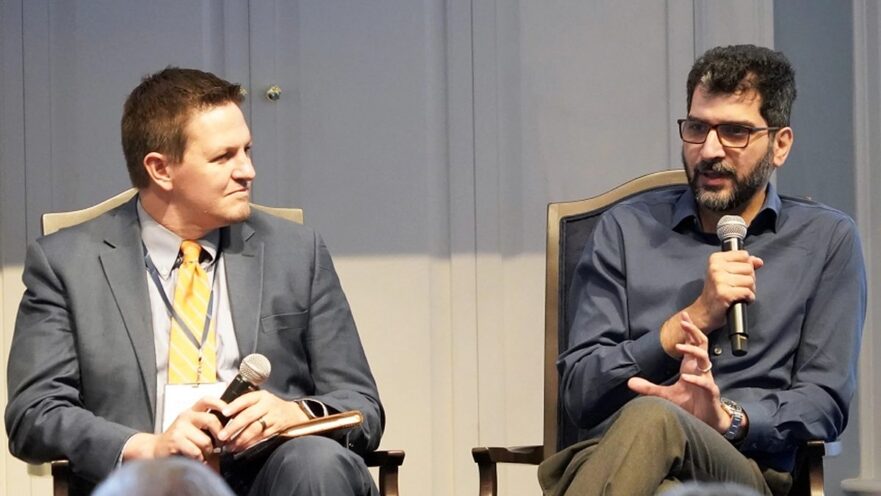
Image caption: Wissam al-Saliby (right) speaks at the Global Religious Freedom Gathering in Dallas, Sept. 29, 2026. Photo: Christian Daily International
21Wilberforce President Wissam al-Saliby joined fellow religious freedom advocates on Sept. 29, 2026, for a panel at the Everett Center for Global Religious Freedom’s Global Religious Freedom Gathering at Dallas Baptist University. The session, “Advocacy in a Broken World: Faithful Action in Times of Conflict,” was moderated by Scot Bower of Christian Solidarity Worldwide.
Wissam shared the panel with Bob Fu of ChinaAid, Ted Vail of the Pentecostal Commission on Religious Liberty and Jeremy P. Barker of the Mustard Seed Foundation. The Gathering holds special meaning for 21Wilberforce: the Everett Center for Global Religious Freedom at Dallas Baptist University bears the name of Randel Everett, our founder and former president.
Christian Daily International covered the panel, highlighting Wissam’s insights on how armed conflict is reshaping religious freedom advocacy.
When conflict closes doors
Wissam noted that 65-armed conflicts are active worldwide, counting both wars between states and civil wars. Many more regions face violence from armed or separatist groups.
He outlined three ways war damages religious freedom:
- It weakens or destroys civil society inside a country, as in Sudan.
- States at war tend to restrict religious freedom alongside freedom of expression, as seen in Russia and Iran.
- It disrupts international advocacy. The United Nations and similar bodies also carry less weight than they did five years ago.
Wissam shared an example from 21Wilberforce’s own work. In one campaign, U.S. lawmakers would not take up a religious freedom case because of a conflict involving the United States. So, our team turned to the Swiss parliament, seen as a neutral voice, which agreed to send letters to that country’s government. The approach worked for a time, until the threat of war closed that route as well.
From advocacy to peace building
Conflict divides Christians themselves, too. Soon after Wissam became president of 21Wilberforce in May 2024, he asked a Christian leader in a conflict region how we could help. The leader’s answer was clear: their community was divided, and unity had to come first.
That conversation moved 21Wilberforce toward peace building, healing and reconciliation alongside our advocacy. Wissam explained that conflicts often split churches along tribal and ethnic lines, a pattern that repeats across countries.
He also cautioned that resentment toward other communities works against the church’s mission and makes conflicts harder to resolve. In one country, local Christian leaders chose to advocate jointly with Muslims. Not everyone embraces that approach, he acknowledged, but it has proven more effective.
Following the local church
Wissam described a principle that guides how 21Wilberforce works with partners. On the morning of the panel, he received a petition about one country that was circulating in the United States. He explained that 21Wilberforce would not sign it until our local partners there had reviewed and approved it.
Other organizations work differently, he noted, but 21Wilberforce is committed to following the lead of the local church.
During the Gathering, Wissam and Ted Vail also discussed how Baptists, evangelicals and Pentecostals could work together in specific countries. Building trust across denominations, both agreed, starts with relationships.
From conflict zones to the halls of foreign parliaments, 21Wilberforce continues to stand with persecuted believers, listening first to the local church and working with partners to turn mission into lasting impact.
Read the full coverage: Conflict, surveillance, disunity emerging as new religious freedom challenges, advocates say, Christian Daily International, Oct. 1, 2026.
October 5, 2026