
It was around 2 a.m. during an all-night “tarry,” as Liberians call a lock-in of worship and prayer, when Marsha Scipio finally stopped arguing with God.
She was a Princeton Theological Seminary student, spending the summer in a field placement at Providence Baptist Church in Liberia. She had come to seminary with a lawyer’s plan: learn to write Bible-based curricula for unchurched youth of color, then return to the work she had been doing.
Then, in the middle of worship in the church’s “Old Church,” she says the Holy Spirit spoke the words of Isaiah 61 to her “as clearly as if I was having a conversation with someone.” She opened her Bible to the passage and wept.
“I knew in that moment, if I did not stop trying to impose my own will above that of the Lord’s for my life, I would be in trouble,” she says.
Today, Scipio serves as director of Baptist World Aid (BWAid), the relief and development ministry of the Baptist World Alliance, working with Baptist churches and partners around the world to respond to war, disaster and poverty while helping communities build lasting solutions. Isaiah 61, the prophet’s announcement of good news to the poor and freedom for captives, remains what she calls “the litmus test” for whether she is living in obedience to God.
A village church and a bucket in the yard
Scipio’s understanding of faith began in a village in southern Trinidad and Tobago. The village Catholic church was a place of worship, but just as important, she says, it was where people experienced community. No one went hungry or without water as long as someone else had food on the table or a bucket in the yard.
“I learned as a young child that faith was defined and strengthened by both how we experienced God in community and how we cared for and served one another,” she says.
Her family later moved to Crown Heights, Brooklyn. She grew up four blocks from Eastern Parkway, the line dividing the neighborhood’s African American and Afro-Caribbean residents from its Orthodox Jewish community. It was only a few blocks from where the death of 7-year-old Gavin Cato set off the Crown Heights riots in 1991. There she saw what under-resourced communities “looked, felt and smelled like,” and she met prejudice and racism firsthand. As an immigrant, she contended with an added layer of being treated as an outsider.
By fourth grade she was asking questions at school about justice and fairness. She was beginning to see that opportunities were not the same for everybody, and that the differences were systemic.
From the law to the pulpit
Scipio’s heart for justice grew through high school and college. She went on to earn a law degree from Georgetown.
Her road to ministry began at Legal Outreach, a law-related education program. One of its optional activities was “Phat Phriday,” an interactive Bible study with a good meal. Scipio was amazed by how many young people came, most of them unchurched, eager to ask questions about Christ.
“This was the first time I found myself having to explain why I believed in God; why my faith mattered to me,” she says.
That led her to Princeton’s youth ministry program. Midway through her first year, she began sensing a call to preach. “I fought and fought against the idea,” she says.
The person who helped her stop fighting was Pastor Sam Reeves of Providence Baptist Church, himself a Princeton alumnus. His church’s work among the poor and the broken gave Scipio a vision of what it means to “be a church” that represents Christ in its community.
Reeves also nudged. Knowing she was terrified of preaching, he gave her books about women preachers and encouraged her to listen to sermons. Most important, he helped her see that her law degree and years of community work did not stand in the way of her calling. They were preparation for it.
“I did not have to discard my previous experiences or become someone different to answer God’s call,” she says. “God could use all of it.”
In seminary, two courses turned her lifelong passion into a theological conviction: a study of the Old Testament prophets, and a course on Reinhold Niebuhr and the Rev. Dr. Martin Luther King Jr. Coming to know God as Jehovah Mishpat, the God of justice, “made all the difference,” she says.
“Perhaps the most significant realization was that I could bring my whole self to the Church,” she says.
“God wastes nothing”
At BWAid, Scipio draws on every chapter of that story. One week she may review donor contracts or write organizational policies. The next, she may help a partner design a development program or lead a “share table” where grantees trade best practices.
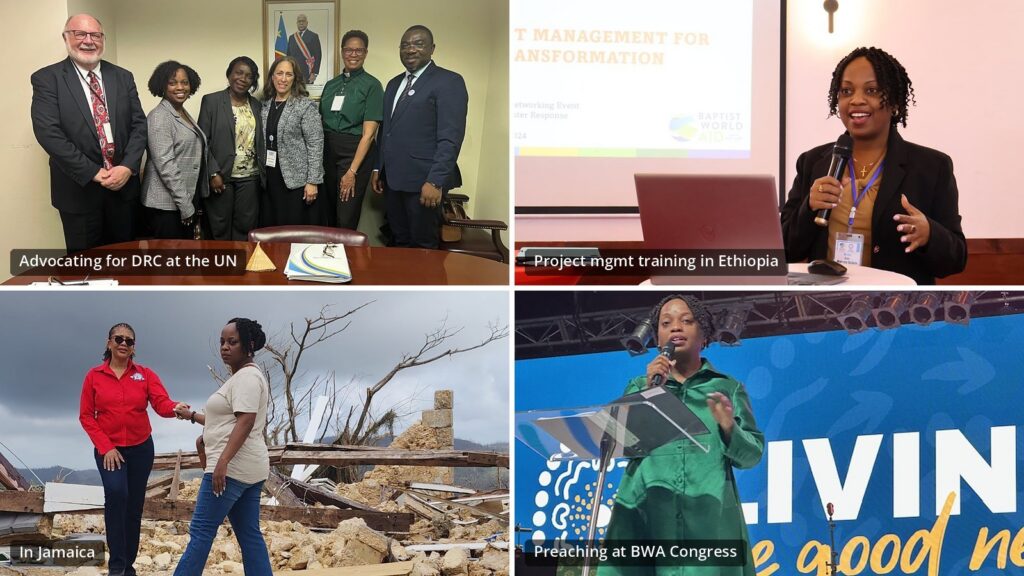
Her work has also brought her into partnership with 21Wilberforce, another ministry of the Baptist World Alliance. 21Wilberforce identifies partners with shared priorities and equips the partners to apply for BWAid funding. Together, 21Wilberforce and BWAid have worked alongside local partners in a Manipur trauma healing project, aid for people displaced in Manipur, and in training 21Wilberforce Nigeria partners on aid standards.
“As the Senior Saints would say, ‘God never wastes anything,’” she says.
Her first trip to Ukraine, in March 2022, tested that faith. Traveling from Hungary with leaders of Hungarian Baptist Aid, she met a pastor who had stayed when many others fled, and who had turned his church into a shelter for displaced people. Standing outside under a gray sky with the pastor’s sister, Scipio heard sirens and jumped. The sister explained calmly that a missile had been fired, then added: “I’m here, knowing I could die at any minute, but I want to help.”
Scipio asked herself whether she could say the same. In that moment, her honest answer was no. Four years and many volatile trips later, she says, “I have not made a decision to die, but I have determined that I will follow Christ where he sends me. I no longer have a comfort zone.”
The 21st-century Jericho Road
For Scipio, the “21st-century Jericho Road” means all the structures, institutions and systems that rob people of their dignity. To understand the Good Samaritan story, she says, we have to look at the dangerous road itself, not only at the actions of the men who passed by.
That shapes her vision for BWAid. Emergency relief is necessary, she says, but often insufficient and unsustainable. “My prayer is for us to get to a space where simply sending bags of rice to people in need becomes a very small part of what we do.” The larger mandate is to help people recognize their own gifts and power to transform their communities, and to build systems that meet their own needs.
She sees evangelism and justice as one calling, pointing to Jesus’ own statement of purpose in Luke 4:18-19. Following Christ, she says, means inviting people into relationship with him while seeking “the dignity and flourishing of all God’s children.”
But for Scipio, transforming lives is not only about responding to crises or changing the systems that keep people marginalized. It is also about recognizing the gifts God has placed in others. That commitment has shaped another important part of her ministry: encouraging women to claim their place in the work of the Church and the world.
The lives we touch
Scipio founded Women Who Minister, she says, because God gave her clear instructions to do so, and because so many women serving in the church and the marketplace did not dare think of themselves as ministers. What she expected to be one conference became a movement. At its 10th anniversary last year, women testified to starting seminary, answering their calls, launching businesses and being healed.
At this year’s conference in October, four young women she has mentored across three decades were in the same room for the first time. She loved watching them laugh, trade advice and, yes, make fun of her. “I was able to see something of God in each of them,” she says.
One young man she worked with after college still texts her about four times a year: “Hi Mentor, I love you. Thank you.”
Her personal motto comes from Maya Angelou: “I wouldn’t take nothing for my journey now.” To Scipio, it means a life of abandonment to God. “My greatest fear,” she says, “is to find myself out of God’s will.”
Her message to the next generation of Christians who want to pursue justice and compassion borrows from one of her own mentors: “Be found faithful.”
Above all, she urges them to pursue and protect their relationship with Christ. “Christ will prepare their heart, mind and spirit for this work,” she says.
November 24, 2026
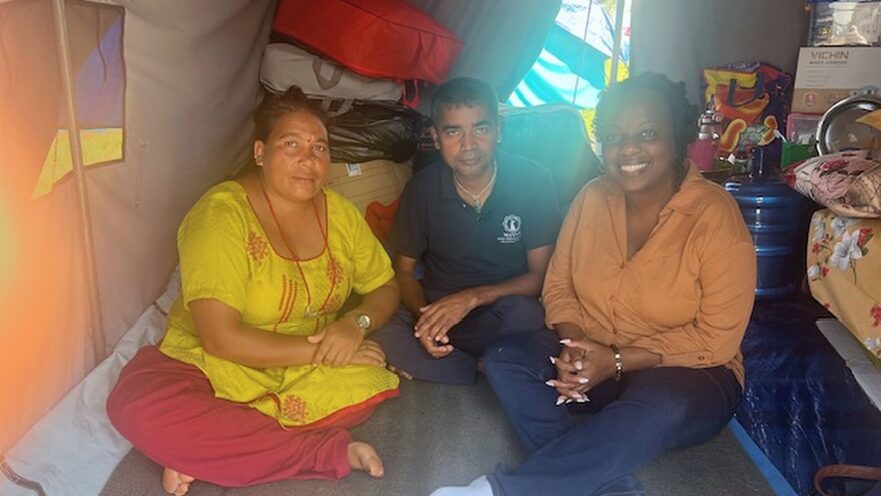
Feature photo: Marsha Scipio of BWAid sits with a woman and a local partner inside a family’s tent in Nepal.