March 6, 2026
The United States Commission on International Religious Freedom (USCIRF) has released its 2026 Annual Report documenting religious freedom conditions around the world in 2025. The findings are sobering. Yet the report is more than a catalog of atrocities—it is a warning and a call to action.
For pastors, ministry leaders, and advocates who care about the persecuted church and the freedom of conscience for all people, the report highlights three urgent realities: religious violence is intensifying in fragile states, authoritarian governments are weaponizing law and technology against faith communities, and U.S. leadership on international religious freedom is approaching a critical inflection point.
Nigeria: A Case Study in Converging Crises
The cover of this year’s report centers on Nigeria—and for good reason.
 According to USCIRF, nearly 53,000 civilians have been killed in targeted violence since 2009, with roughly 21,000 deaths in just the past five years. In 2025 alone, gunmen abducted more than 300 children from a Catholic school dormitory. A Christian priest was executed. A market vendor was burned alive following blasphemy accusations. Muslim and Christian communities alike continue to face mass kidnappings, extremist violence, and impunity.
Nigeria’s crisis is not reducible to a single narrative. It is a complex convergence of jihadist insurgencies, criminal banditry, corrosive blasphemy laws, ethnic tensions, and weak governance. Both Christians and Muslims suffer. Houses of worship are bombed. Clergy are targeted. Entire communities are displaced.
In October, President Donald J. Trump designated Nigeria a Country of Particular Concern (CPC), a step long recommended by USCIRF. That designation matters. But designation alone does not protect a single worshiper. It must be paired with sustained diplomatic engagement, targeted sanctions on perpetrators, and meaningful accountability measures.
For the Church in America, Nigeria is a reminder that religious freedom is not an abstraction. It can be a matter of life and death.
The Expanding Toolkit of Repression
While Nigeria represents the chaos of nonstate violence, other nations demonstrate how modern states are perfecting repression.
In China, authorities intensified their campaign to eliminate independent religious expression. Protestant house churches were raided. Religious leaders were detained. Surveillance technologies continue to monitor and restrict worship outside state-approved structures. The repression of Uyghur Muslims and other minorities remains emblematic of systematic, state-driven persecution.
In India and Pakistan, mob violence and blasphemy accusations have fueled attacks on minorities and destruction of homes. In Central Asia, new religion laws compound registration barriers and criminalize peaceful religious activity. In the Middle East, dissidents and minorities face imprisonment, execution, and social erasure.
USCIRF also highlights a disturbing global trend: the weaponization of legal frameworks. Governments increasingly use zoning laws, registration requirements, extremism statutes, and national security justifications to shutter congregations and imprison leaders. The result is repression with a bureaucratic face.
Even more troubling is the documented correlation between mass atrocities and religious freedom violations. Where religious freedom collapses, violence often follows. Restrictions on belief and worship are not secondary concerns; they are early warning signs.
Conflict Zones and the Rise of Sectarian Fragility
The report also underscores how religious freedom deteriorates rapidly in conflict and post-conflict settings.
In Syria, the fall of the former regime did not end sectarian violence. Massacres targeting Alawi and Druze civilians, along with attacks on Christian churches, raised fears that transitional authorities may lack either the will or capacity to protect religious minorities.
Across parts of Africa, militant groups continue to attack Christian and Muslim communities alike. In Sudan, religious violence compounds one of the world’s worst humanitarian crises. In the Democratic Republic of the Congo, ISIS-affiliated militants have murdered hundreds, often with grotesque brutality.
These environments reveal a hard truth: when governance collapses, religious minorities are often the first—and easiest—targets.
The U.S. at a Crossroads
Beyond documenting violations, USCIRF evaluates U.S. implementation of the International Religious Freedom Act of 1998 (IRFA), which created the Commission and established tools such as CPC (Country of Particular Concern) designations, sanctions, visa restrictions, and refugee protections.
In 2025, there were notable developments. Senior administration officials publicly affirmed support for international religious freedom. Nigeria was designated a CPC. Congress introduced numerous religious freedom–related measures.
At the same time, the report notes significant reductions in refugee admissions and the termination of multiple religious freedom–specific programs. Several key designation deadlines passed without comprehensive action. The Office of International Religious Freedom funded no new IRF-specific programs in fiscal year 2025.
This mixed record underscores why USCIRF’s policy recommendations matter.
What USCIRF Is Recommending
The 2026 report is not merely descriptive; it is prescriptive.
USCIRF recommends that the State Department designate 18 countries as Countries of Particular Concern (CPCs) for “particularly severe” violations of religious freedom, and place 11 additional countries on the Special Watch List (SWL) for severe violations. It also recommends seven nonstate actors be designated as Entities of Particular Concern (EPCs), recognizing that in many contexts, militias and extremist organizations—not just governments—are primary persecutors.
Beyond designations, the Commission urges the administration and Congress to:
- Fully implement IRFA’s sanctions and accountability tools, including targeted visa bans and financial sanctions on individual violators.
- Prioritize the timely release of the State Department’s own International Religious Freedom Report and required country designations.
- Strengthen refugee and asylum pathways for individuals fleeing religious persecution.
- Restore and expand religious freedom–focused foreign assistance and programming.
- Integrate religious freedom more consistently into bilateral diplomacy and multilateral engagement.
In short, USCIRF is calling for religious freedom to be treated not as a symbolic value, but as a strategic and moral priority embedded across U.S. foreign policy.

Wissam al-Saliby, president of the 21Wilberforce
Responding to the report, Wissam al-Saliby, President of 21Wilberforce, stated: “The 2026 USCIRF report makes clear that freedom of religion or belief is being tested in some of the most fragile and strategic regions of the world. At 21Wilberforce, we see these pressures firsthand — in Nigeria, where communities face relentless violence; in Southeast Asia, where legal restrictions and forced displacement threaten vulnerable minorities; and in other parts of the world where faith communities are targeted simply for living out their convictions.
Our commitment is to stand with those communities — through advocacy, partnership, and principled engagement — so that religious freedom is not merely a policy ideal, but a lived reality for people of every faith.”
Why This Matters for the Church
For Baptist and Evangelical pastors, human rights advocates, ministry leaders, and all people of faith, the implications are clear.
First, prayer must remain central—but prayer should be informed. The report provides concrete country contexts that churches can lift up intentionally.
Second, advocacy matters. IRFA gives the U.S. government tools—sanctions, visa bans, diplomatic leverage—but those tools require political will. Faith leaders can help ensure religious freedom remains at the forefront of U.S. engagement abroad.
Third, solidarity must be holistic. Religious freedom is not a Christian-only issue. In Nigeria, Muslims and Christians alike are targeted. In India and Pakistan, minority communities of many faiths suffer. Defending freedom of religion or belief means defending the dignity of every person made in the image of God.
The 2026 USCIRF report does not offer easy optimism. But it does offer clarity. Religious persecution is neither isolated nor accidental. In many places it is systematic, strategic, and escalating.
That is precisely why informed engagement matters. The USCIRF report equips policymakers, faith leaders, and advocates with data and analysis needed to respond wisely and persistently.
We encourage pastors, ministry leaders, and concerned citizens to download and read the 2026 USCIRF Annual Report, pray for the communities it highlights, and share its findings with others in your church, organization, and network. Awareness is the first step toward action—and sustained attention is often what ensures that the persecuted are not forgotten.
When the global church understands the realities facing believers and other faith communities around the world, it is better prepared to stand with them in prayer, advocacy, and partnership. The report is not simply a document; it is a tool for strengthening the collective witness of those committed to defending freedom of religion or belief for all.
Watch the USCIRF 2026 Annual Report publication event here.
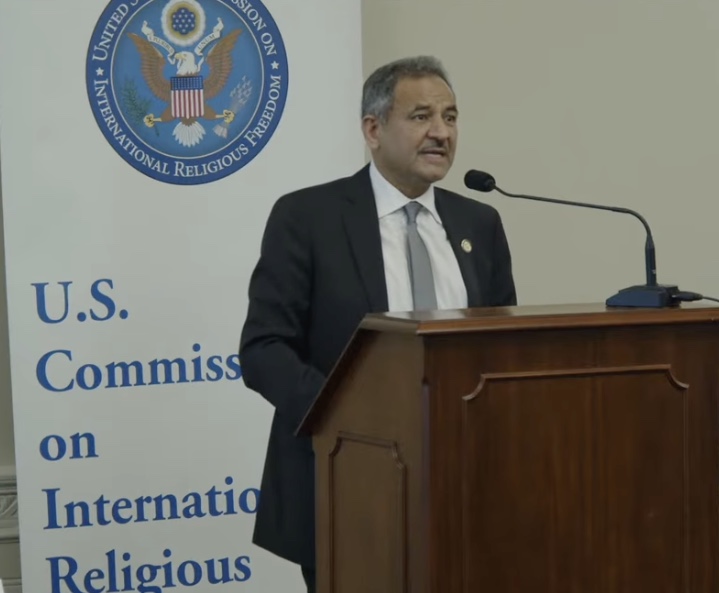
Photo caption: Dr. Asif Mahmood, Vice Chair, USCIRF, speaking at the 2026 USCIRF Report publication event held on Capitol Hill in Washington, DC. Photo credit: YouTube screen capture.