The debate over state policing in Nigeria raises a broader question for Christians facing persecution and insecurity around the world. What do we do when no solution appears perfect, and every path forward carries risk?
Too often, uncertainty can lead to paralysis or defeatism. We may conclude that the problems are too large, the systems too broken, or the obstacles too entrenched to make meaningful progress. Yet Christians are called not to withdraw from difficult circumstances, but to pursue justice, peace, and security even when outcomes are not guaranteed.
In June, Nigeria took a major step toward reforming its security system when legislators approved a constitutional amendment that would, for the first time, allow states to establish their own police forces. We emailed our newsletter subscribers, asking for prayer support for both Nigeria’s political leadership and Nigerian Christian leaders as they navigate this new phase in the country’s politics. In our prayer request, we explained:
“If fully implemented, state policing could significantly improve security and protection for vulnerable populations. However, much work remains. State governments will need to recruit, train, equip, and fund these new police forces while ensuring strong accountability and oversight.”
Not everyone shares that assessment. One human rights advocate replied to our prayer request to share concern that state policing could exacerbate corruption and further endanger vulnerable communities, including Christians in northern and central Nigeria. Those concerns deserve serious consideration.
The security crisis in central and northern Nigeria has no easy or immediate solution. I do not view the constitutional amendment as a solution in itself, but as an opportunity to pursue one. It reshapes the politics and incentives surrounding law enforcement and domestic security. It could improve security—or simply reproduce existing failures at a different level. Without strong accountability, the amendment risks weakening existing oversight. At the same time, greater local control could give citizens more opportunity to hold state authorities accountable for security outcomes. The question is whether Nigerians can seize this opportunity and shape it for the common good.
At 21Wilberforce, we listen to local Christians, journey with them as we identify opportunities for engagement, and design our advocacy accordingly. This reflects our conviction that Christian advocacy is not separate from God’s mission. It is one way we participate in His work of seeking justice, protecting the vulnerable, and advancing human dignity.
I visited Nigeria last September, where 21Wilberforce convened two consultations with Christian leaders. During those discussions, I heard hopeful expectations and serious concerns regarding state policing. The conversations were realistic, nuanced, and rooted in the lived experiences of communities facing insecurity every day.
In June of this year, following the National Church Denominational Leaders’ Summit 2026, the Christian Association of Nigeria called “for the immediate acceleration of constitutional and legislative processes leading to the establishment of State Police and other lawful decentralized security structures capable of improving intelligence gathering, rapid response, and local accountability,” while simultaneously reminding “the Federal Government that the protection of lives and property remains its foremost constitutional responsibility.”
Most Nigerian Christians view this constitutional amendment as an opportunity worth pursuing despite its risks. Their posture offers a challenge to the global Church. Rather than standing at a distance and assuming failure, how can we support Nigerian Christians as they seek to shape the future of their country?
This conviction extends beyond Nigeria. Around the world, Christians facing persecution often confront situations where every available option appears flawed or inadequate. Governments may be weak. Institutions may be corrupt. Political reforms may carry both promise and risk. Yet our calling is not dependent on certainty of success. Faithfulness requires engagement even when outcomes remain unclear.
We need to invest in the capacity of Nigerians to drive advocacy, research, policy development and public engagement. We need to support those who are working to strengthen institutions, protect vulnerable communities, and advance peace and security for all. This is where 21Wilberforce is investing its resources.
However, this does not mean we subscribe to the saying: “African solutions for African problems.” Far from it, we believe in “church family” solutions for the problems in a given country or region. We come alongside those persecuted as those sharing in their suffering and as co-laborers in advocacy.
In the face of extreme adversity and violence, withdrawal and defeatism are not options. We believe that God’s Kingdom is at hand and that He comforts the poor, the widow, and the orphan through the work of His people. As followers of Christ, we are called to engage with earthly institutions and advocate for righteousness and justice while recognizing that our ultimate hope lies beyond them.
We must resist the temptation to conclude that corruption is inevitable, violence is permanent, or efforts toward justice are futile. The challenges may be enormous, but Christian faithfulness has never depended on favorable circumstances. Even in the face of daunting obstacles, we remain committed to God’s mission of pursuing justice, peace, and security.
And we do so as people whose eyes are fixed on the heavenly city, where God will wipe every tear, where mourning and suffering will cease, and where there will be no more bloodshed. That future hope does not lead us to disengage from the world’s problems. Rather, it gives us the courage to confront them with perseverance, confidence, and faith.
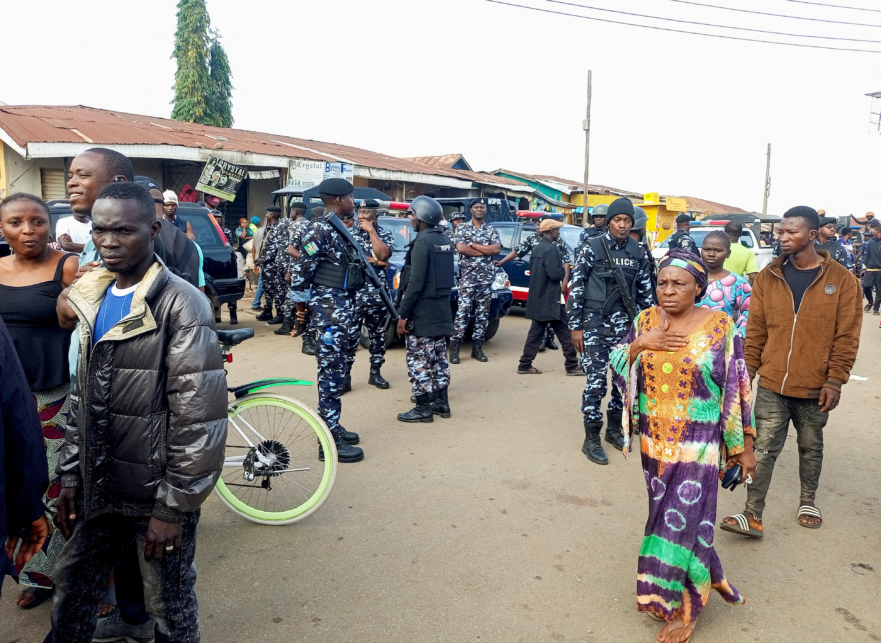
Photo: Plateau State, Nigeria. Credit: Reuters
June 22, 2026