
By Wissam al-Saliby
I recently visited more than a dozen church pastors across the United States to share about the ministry of 21Wilberforce. During these visits I discussed religious persecution and 21Wilberforce’s response to it. At times, our conversations broadened to include church growth in the Middle East, geopolitics and foreign policy, U.S. domestic politics (not that I am an expert), Christian ethics in international law, and even my former work in Geneva.
Several pastors raised the challenge of discipling church members regarding public and political engagement in an increasingly divided country. Two pastors, in particular, described difficulties around political partisanship, questions surrounding pro‑life convictions, and whether Christians ought to vote Republican or Democrat. Others asked about U.S. foreign policy toward the Middle East and the Israeli-Palestinian conflict, seeking perspectives not readily available in U.S. media. In Florida, a young pastor shared that some young people in his church view theonomy as a compelling framework for Christian political engagement; a term I had to look up online afterward.
Taken together, these conversations revealed something I had not fully recognized before. Growing up in an Evangelical church in the Middle East, the question of an Evangelical Christian’s relationship to power was not something we discussed. We were a numerical minority in Lebanon—Christians are a minority like other faith groups, and Evangelicals are a minority within the Christian community—so we had no access to political power or meaningful opportunity to gain it.
The only time I recall engaging in sustained discussion about theology and political engagement was in 2015, when pastors and ministry leaders considered whether to join or endorse the anti‑government “you stink” demonstrations (which began as a response to garbage‑collection failures). Evangelicals in countries ranging from Nepal to Nigeria recently faced similar questions during unrest and protests.
Still, we faced one less temptation.
Our minority status, stripped of political power, meant that governing, legislating, and shaping policy were not within reach. As a result, we did not need to debate a theology of “Christian” governance and political power.
It is, perhaps, easier to affirm our heavenly citizenship when our earthly citizenship is marginalized and when Christians and churches are on the periphery of political systems.
The Beatitudes in Matthew 5 portray the blessedness of those who are poor in spirit, meek, persecuted, and without earthly power—showing spiritual strength apart from worldly authority. Without power, our worship, love of neighbor, humanitarian aid, calls for justice and righteousness, and challenge to religious persecution all strongly embody the eschatological hope we have in Jesus.
I do not write this as a call for churches that are majority faith groups, or whose size provides political influence, to face persecution or be relegated to minority status. On the contrary, I pray that such churches and their leaders would remain faithful to God’s calling, bear much fruit, and exercise their influence in ways that bless culture and society.
But I do offer this encouragement: that these churches and believers would intentionally engage with churches living as minorities—to stand with brothers and sisters in the Middle East, Asia, and Africa—and to discern God’s shared calling and purpose for the body as a whole.
Such engagement is not merely informative; it is formational. It serves as a valuable instrument in the work of discipleship, a lived pursuit of the unity Jesus prayed for in John 17, and a means to inform and shape our political theology.
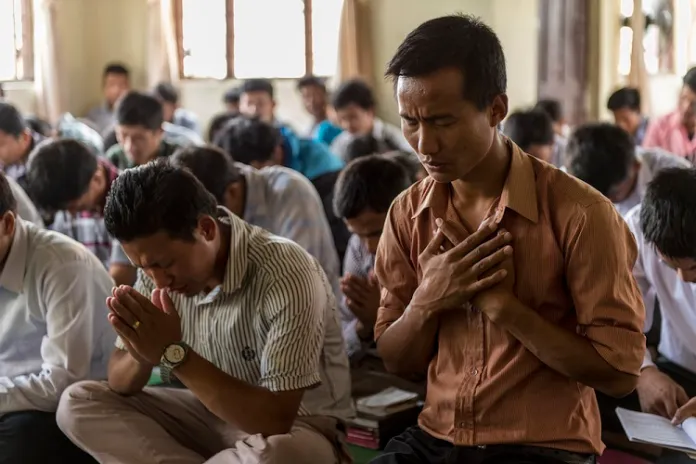
Photo credit: Gospel for Asia
March 30, 2026