
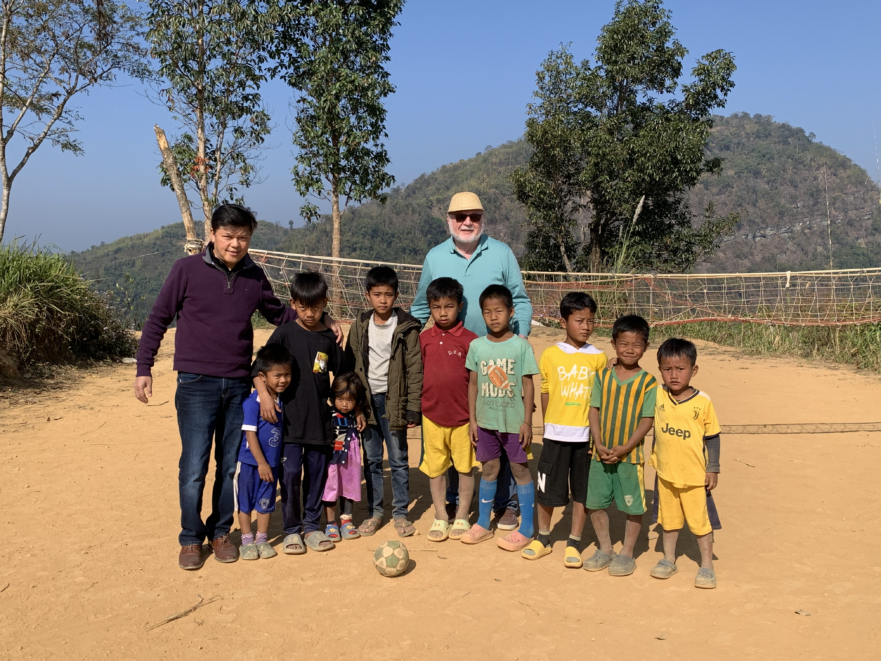
Through prior work with the Burma Advocacy Group on advocacy initiatives addressing persecution and displacement in Burma and his service for the Baptist World Alliance, 21Wilberforce has come to know the leadership and witness of Rev. Dr. A. Roy Medley. His life story offers a powerful window into the faith, moral clarity, and interfaith commitment that animate this shared work.
February 2, 2026
The seeds of Rev. Dr. A. Roy Medley’s lifelong commitment to justice were planted early—long before he held positions of national or global leadership, and long before interfaith cooperation became a recognized field of peacebuilding. They were planted in the red clay and hard realities of the American South.
Growing up in the 1950s and 1960s, Medley spent most of the year in North Georgia and part of each year in South Alabama. It was a childhood shaped by poverty and by segregation—by watching families work relentlessly yet remain unable to meet their basic needs, and by witnessing a society structured to deny dignity to people of color. As a boy, he voiced a question that never left him: Why do the dogs of the rich eat better than the children of the poor? Laziness was not the answer. Exploitation—personal and systemic—was.
At the same time, Jim Crow laws enforced racial hierarchy with fear and violence. Even as a child, Medley felt the contradiction between what he heard in church about God’s love and what he saw lived out in society. One moment, in particular, crystallized that tension. During Vacation Bible School, a teacher finished telling the parable of the Good Samaritan—Jesus’ radical call to love one’s neighbor. Another boy raised his hand and asked whether that meant loving Black people. The teacher replied yes—but qualified it by saying such love did not require respect or equality. At nine years old, Medley knew something was profoundly wrong.
That intuition deepened as he encountered the witness of civil rights leaders—both Black and white—who risked everything to confront segregation: Martin Luther King Jr., Rosa Parks, Clarence Jordan, Will Campbell. Their lives helped him understand that discipleship to Jesus was not merely personal piety, but public faithfulness.
Though he felt an early call to ministry, Medley initially resisted it. He was disillusioned by a church more concerned with policing personal behavior than confronting racial injustice. He did not want a vocation that debated soft drinks while ignoring stripped human dignity. Yet formative doors opened. At Princeton Seminary and through the Ecumenical Institute of the World Council of Churches, Medley encountered the global church—and a theology that refused to separate love of God from justice for neighbor.
He found a spiritual home among American Baptists, where deep personal faith and social righteousness were not in conflict, but mutually reinforcing. Faith, for Medley, had become something consciously wrestled with and chosen—shaped by obedience to Christ that extended far beyond individual morality into social responsibility.
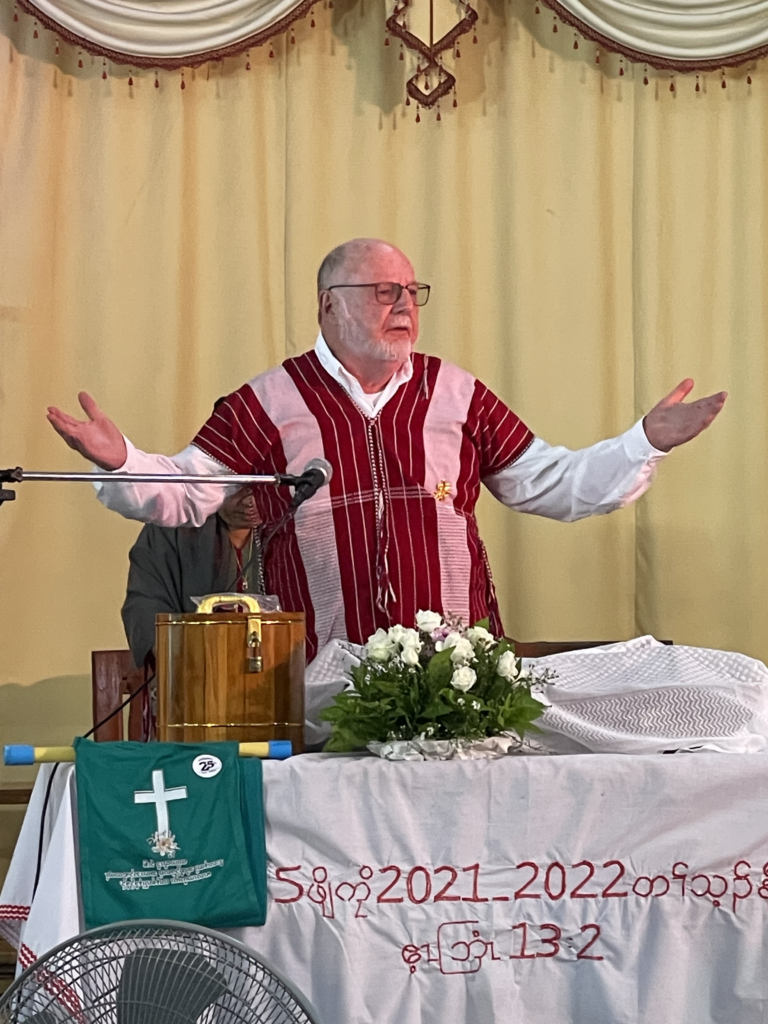
Rev. Medley leading communion at Mae La Refugee Camp, Thailand.
Over time, his ministry expanded well beyond the walls of the church. He came to see that religious communities often misunderstand their own power in the public sphere. When faith becomes a “gated community of the saved,” justice is optional and the prophetic tradition is silenced. Scripture, as Medley reads it, allows no such separation. Justice and mercy are not secondary concerns; they are of the essence of biblical faith.
That conviction led him into interfaith engagement—not as a dilution of Christian identity, but as an expression of it. Authentic dialogue, he insists, requires two things: fidelity to one’s own faith and the humility to listen deeply to others. Over decades of engagement with Jews, Muslims, Buddhists, Hindus, and others, Medley’s assumptions were challenged. He encountered people of other faiths whose devotion to God and moral seriousness exceeded that of many Christians.
Interfaith relationships also became teachers. From Muslims, he learned disciplined prayer. From Jews, perseverance through suffering. From Buddhists, the power of silence before God.
In 2010, these convictions took public form when Medley helped launch Shoulder to Shoulder, a national interfaith initiative responding to rising Islamophobia in the aftermath of 9/11. At a time when Muslims were increasingly portrayed as enemies, Christians and Jews stood publicly alongside them—not merely to defend their rights, but to affirm shared humanity and citizenship. As a Christian leader in a majority-faith context, Medley believed such solidarity was not optional.
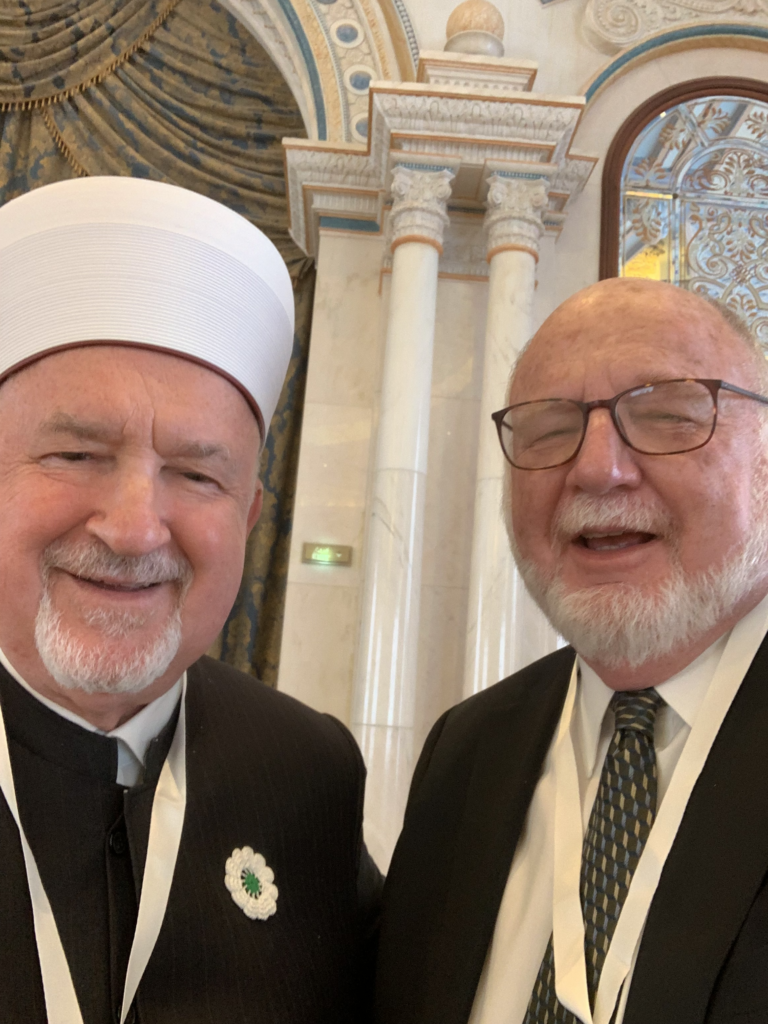
Rev. Medley with the former Grand Mufti of Bosnia Mustafa Ceric at a 2022 interfaith conference.
The risks were real. Interfaith work was dismissed by some as naïve or politically dangerous. Yet its impact was undeniable. After years of sustained Baptist–Muslim dialogue, an imam reflected, “We came here knowing we would be respected, but we discovered we are loved.” For Medley, that sentence captured the heart of peacebuilding: dismantling fear by replacing it with relationship.
He has seen interfaith cooperation save lives. When a Christian woman named Miriam Ibrahim was sentenced to death in Sudan, Medley was part of an interfaith delegation—organized by a Muslim American—that met with the Sudanese ambassador. Jews, Muslims, and Christians advocated together. Miriam was freed the next day.
“Interfaith cooperation makes a tangible difference for peace, justice, or human dignity,” notes Medley. ” In the immediate aftermath of 9/11, I saw Christians gather around mosques to protect them. In the midst of a wave of Muslim extremism in Indonesia, I heard a Baptist pastor speak of how the Muslims of his community surrounded his home and church to protect the Christians gathered there. My own Baptist tradition has long contributed its emphasis on “soul freedom” and religious freedom to the world stage and has helped to influence its presence in the laws of many nations. Within the Muslim world, efforts such as that which led to the Marrakesh Declaration are being made by Muslims to promote the principles of what we call religious liberty.”
Today, as Executive Director of the Burma Advocacy Group, a coalition of over 20 US.-based church and advocacy organizations representing the Burmese diaspora, Medley continues to practice what he believes: peace must be sought and pursued. His work focuses on the persecution of Christians under successive military regimes, massive displacement of civilians, and the world’s failure to respond with moral clarity. Millions remain internally displaced or living as refugees. Fear—of governments, of reprisal, of one another—continues to silence prophetic voices. Globally, Burma ranks in the top tier of nations with displacements created by active conflict. The refusal by the US government and others to resettle these refugees or to provide humanitarian aid we believe is contrary to our faith. It has left them devastated.
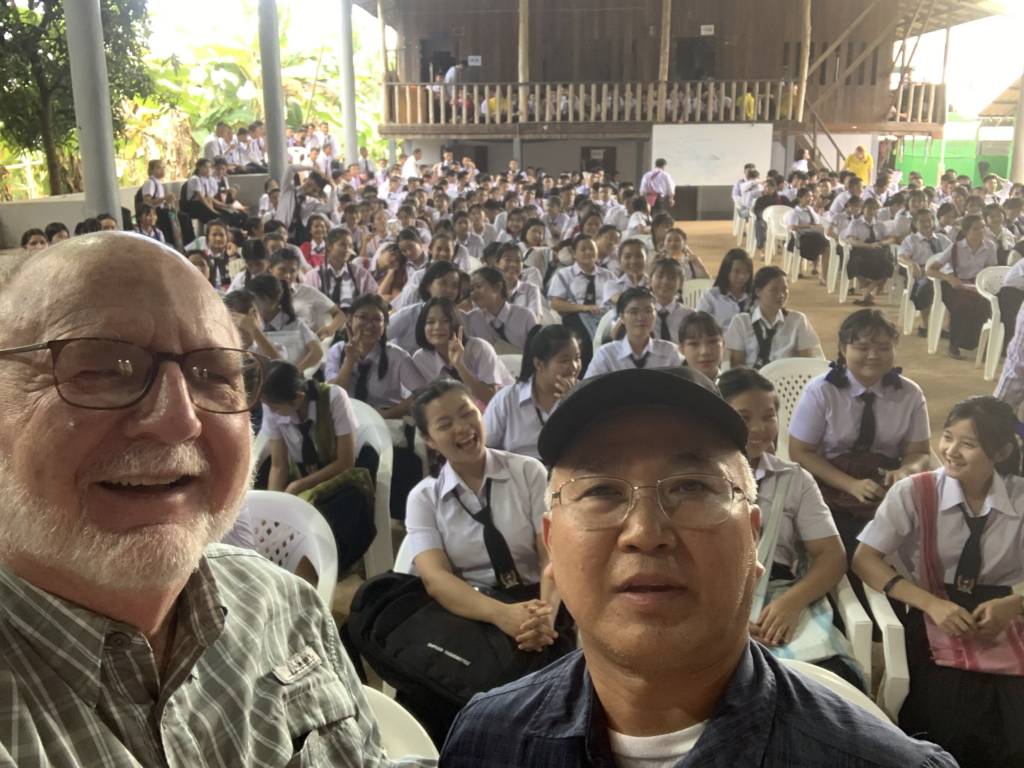
Rev. Medley visiting a Bible school on the Thai-Burma Border.
Medley does not romanticize this work. Faith-based advocacy faces the overwhelming power of geopolitical interests. Leaders who speak out often pay a high personal cost. Yet what sustains him is not abstraction, but proximity: visiting refugees, listening to their stories, witnessing their faith.
What keeps hope from becoming naïve, he says, is the cross. God’s intervention for justice was resisted by the powers of the world. And yet the resurrection reminds us that suffering does not have the final word. For Burma, as for all places of violence, Medley’s posture is simple and demanding: pray and act.
Looking ahead, his counsel to emerging faith leaders is clear. Justice, peacebuilding, and interfaith engagement are not optional add-ons to faith; they are its embodiment. They require courage, wisdom, spiritual discipline, and a willingness to endure opposition—even within the church. A close walk with Christ inevitably leads toward the poor, the oppressed, and the “other.”
And yet, Medley insists, there is joy here too. The way of Christ is costly—but it is also full of blessing. Faithful leadership, he has learned, demands humility to seek the counsel of others, courage to act on the principles of our faith, perseverance through personal attacks one faces for staying an unpopular course and relentless prayer.
Above all, it demands trust: in Christ, in the call to reconciliation, and in the slow, holy work of seeking peace—and pursuing it.
Rev. Dr. A. Roy Medley has held numerous leadership roles in national and international faith-based and interfaith organizations, including:
- Executive Director, Burma Advocacy Group
- General Secretary Emeritus, American Baptist Churches USA
- Chair, National Council of Churches (2013–2014)
- President, Friendship Press and Chair, Committee on Bible Translation and Usage, NRSVUE (2017–2021)
- Member, Board of Directors, Berkeley School of Theology
- Member, Baptist World Alliance Commission on Interfaith Relations
- Member, Advisory Board, Karamah: Muslim Women Lawyers for Human Rights
Photo credits: Rev. Dr. A Roy Medley