June 12, 2025
The war in Ukraine began on Feb. 24, 2022, when Russia launched a full-scale invasion. This marked a dramatic escalation of the conflict that had simmered since 2014, when Russia annexed Crimea and began supporting separatist forces in eastern Ukraine’s Donbas region. From 2014 to 2021, fighting persisted between Ukrainian forces and Russian-backed separatists, leading to thousands of deaths. In late 2021, Russia moved 150,000 troops near Ukraine’s borders. Despite diplomatic efforts, tensions escalated.
With the invasion in early 2022, major cities—including Kyiv and Kharkiv—came under attack. Millions of Ukrainians fled their homes, triggering Europe’s largest refugee crisis since World War II. The international community imposed severe sanctions on Russia and sent military and humanitarian aid to Ukraine. The war continues, with Ukraine fiercely resisting and regaining some occupied territories while Russia persists with its aggression.
The War’s Impact on Ukrainian Christians
Ukraine has a long Christian heritage. Before the fall of the Soviet Union, it was known as the “Bible Belt” of the USSR. Eastern Orthodoxy is dominant, alongside significant Baptist, Pentecostal, and Catholic communities. The invasion has had a profound impact on Christians—spiritually, socially, and physically.
Displacement and Church Destruction
- Millions displaced: Clergy and Christians, like other Ukrainians, are among the internally displaced or refugees.
- Churches damaged or destroyed: Hundreds of church buildings have been damaged or destroyed, particularly in Donetsk, Luhansk, Mariupol, and Kharkiv.
- Targeting of religious sites: Russian forces have attacked evangelical churches and Orthodox churches not aligned with the Moscow Patriarchate.
Persecution in Occupied Territories
- Repression: Reports of crackdowns in Russian-occupied areas, especially targeting:
- The Orthodox Church of Ukraine (not affiliated with Moscow)
- Evangelical Protestants
- Greek Catholics
- Churches : Pastors detained, churches confiscated, worship gatherings banned.
Deepening Divisions in Orthodoxy
- In 2019, the Orthodox Church of Ukraine gained independence from the Moscow Patriarchate, which Russia opposed.
- After the invasion, the Ukrainian Orthodox Church–Moscow Patriarchate cut ties with the Russian Orthodox Church, though suspicion and tension remain.
A Pastor’s Reflection on the Impact of the War
Illia Kuvshynov served as a pastor of a Protestant church in Berdyansk, Zaporizhzhia region. Together with his wife, Kateryna, he is raising two children. Russian forces occupied their city on Feb. 28, 2022—three days after the full-scale invasion. Illia recalls the events of that winter that dramatically changed their lives.
We lived in Berdyansk, by the Sea of Azov. I’m a pastor, and my wife and I served together at our church there.
On Feb. 24, 2022, we were awakened at 5 a.m. by explosions. By the third day, Russian forces had taken over our city. Half our congregation left, but we stayed to continue serving.
Our city is not far from Mariupol. When the Russians were bombing the city with powerful bombs, we could hear the explosions, sometimes very close by. During the occupation, our church actively helped those fleeing from Mariupol. Many of them stayed in our church building. We cooked meals for them and delivered food to schools where other refugees had found shelter.
It was extremely cold. There was no gas or heating in the city for six months. One of the Christian brothers from our church went to Zaporizhzhia across the front line to bring back essential medicines and supplies because our city was blockaded. He also evacuated people from Berdyansk. He made over 50 such trips. Sometimes he came under fire.
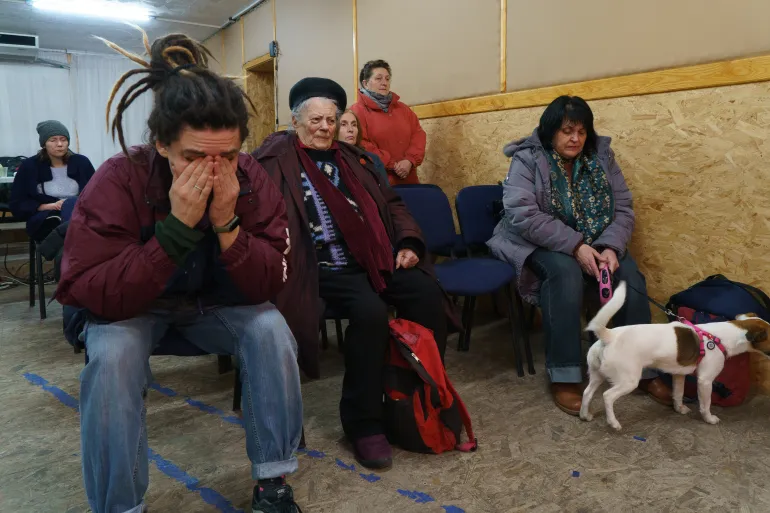
Andriy Voytsekhovskyy prays in the church on the first day of the Russian invasion, Mariupol, Ukraine [Emre Caylak/Al Jazeera]
One evening, six armed men broke into the churchyard. They lined me and another brother up against the wall and threatened to shoot us. They accused us of smuggling weapons through our church. We told them it wasn’t true; we were only providing food and medicine to everyone.
After a few hours of shouting at us and making threats, they left. But the next day, Russian soldiers came to see me again. They detained our brother, a driver, as they knew he had been transporting a former Ukrainian soldier. They accused us of helping these people for several weeks. They threatened to shoot me in the legs and said they wouldn’t release me. But after four hours of interrogating me, they eventually let me go. Thank God, the church wasn’t shut down, and we continued worshipping.
Our brother, the driver, was held in captivity for 43 days and was severely tortured. But thank God, he was finally released and was able to return to his family.
Russian soldiers detained and interrogated me several times. But our story didn’t end there. On March 8, 2024, at 2 a.m., about 15 soldiers violently broke into our apartment. They searched the entire place and accused us of hiding Ukrainian soldiers. They detained me and put me in jail. The next day, they placed a black bag over my head and took me to a basement for torture. They strapped me to a chair and beat me from all sides. They mocked my faith in God and accused me of every possible thing.
It was hard to believe that the Russian soldiers were sane since they told me, “We have liberated you.” What kind of liberation was this? They’ve destroyed our cities, killed our people, including women and children. They abducted me in the middle of the night, tortured me – and this is called liberation?! We can’t even freely express our thoughts. Are we supposed to be grateful for such “freedom”? Are we to be happy with it? And if we aren’t satisfied with this “freedom,” you will just kill us?!
They then tied my hands with wires and shocked me with electricity, while laughing. This is the true “Russian world” they brought to our land.
During the interrogation process, I asked if I could take my family out of the city and leave Ukraine. In response, they began threatening to kill my family as well. Then they placed a grenade in my hand in order to leave my fingerprints on it, and told me that if I tried to escape, I would be framed and sentenced to 12-15 years. After that, I was thrown back into solitary confinement.
By then, many people were already praying for us. I vividly remember spending several hours praying in my prison cell and feeling the incredible presence of God. It was as if the prison walls had vanished and I was surrounded by thousands of people; I felt their prayers and God’s embrace, and my heart was filled with peace. This was a deeply moving experience. I don’t want to go through torture again, but I also long to experience the closeness of God in the same way I did when I was in solitary confinement.
The next day, Russian soldiers promised to release me if I gave them information about people supporting Ukraine and those who wanted our city to be Ukrainian again. They confiscated both Kateryna’s and my Ukrainian passports, preventing us from leaving. For over three months, we were without any documents. The soldiers would come once or twice a week, usually at night, cursing me for not being helpful and refusing to provide the information they wanted. This made them very angry.
God protected our church, and I’m grateful I didn’t reveal any information about our church members. At that time, we were forbidden from worshipping in our church building, so we started meeting in small groups in our homes.
Our friends began warning us that staying in the city any longer was very dangerous and urged us to leave. We learned about the situation in other occupied cities in the Zaporizhzhia region and realized that if I didn’t agree to collaborate with the Russians, I would be sentenced or killed. But how could we leave without any documents?
We continued praying and fasting, not wanting to abandon our people, but we needed a clear direction from God. When I asked the Russians to return our passports, they were furious. But then a miracle happened! After several days of fasting and prayer, a Russian soldier came to me and gave back our passports! We couldn’t believe it and knew this was an answer from God. We decided to leave right away.
As the fighting continued, we had to travel through Russian territory. On our way out of Berdyansk, I started receiving calls from the occupying authorities, telling me to go to the Russian military commandant’s office. We were terrified that we wouldn’t make it to the border in time to leave Russia or that we might be stopped from crossing. A little later, the commandant’s office informed me that they would come for me on Monday. We traveled for two days straight, without resting, to reach the border and leave Russia before then. We prayed that the Russian security services wouldn’t put us on a wanted list or arrest us along the way or at the border.
We crossed the border at night. A Russian female border guard, who was inspecting all our belongings, found a Bible and began questioning me sternly about what kind of book it was. I told her it was a Bible. She asked if I had read it. I said I had read the Bible more than 10 times. At that moment, her demeanor changed, and she said, “Oh, I can’t even read it once! How could you? Is it true that reading the Bible changes your worldview?” I replied, “Yes, it does. This book will definitely change you.” And I began to witness to her about Jesus!
It was a strange feeling: I was being pursued by the FSB and could be arrested at any moment, yet I was so happy to be able to share about Jesus at this Russian border! After that, an FSB officer checked us and allowed us to leave Russia, and also said it was a miracle that we passed all the checks in five hours. Normally, it takes at least 20 hours, and sometimes it even take several days. At that moment, we were convinced that God was guiding us.
After we had already crossed the Russian border, soldiers in our town came to the house of Kateryna’s mother, looking for us. Thank God, our relatives were unharmed.
The church understood our decision to leave. They continue to meet as circumstances allow, and I support them remotely. We hold several Zoom meetings every week.
When Russians say on TV that they are welcome in our cities, they are lying. Russian propaganda lies about everything. The Russians have only brought us pain, destruction, cruelty, and suffering.
But our God reigns. He permits us to endure evil, but He is ever with us. He sustains us. We trust that evil will be defeated. Our God is victorious! Please, pray for the safety of our church in Berdyansk.[1]
Illia Kuvshynov writes: “Since the beginning of this terrible war, my soul has been paralyzed. I think it is the same for many people. It’s hard to believe in the reality of what’s happening. And you don’t even know how to express the turmoil in your soul. This is the first song I was able to write six months after the large-scale invasion began. May God give comfort to every suffering soul. May the pain of your soul resolve in His love.” Watch here.
Eurasia Mission Report: “Faith Under Russian Terror”
In February 2025, Mission Eurasia published Faith Under Russian Terror: Analysis of the Religious Situation in Ukraine. The report documents widespread repression of religious freedom by Russian forces.
It opens:
“The invasion of Ukraine by the armed forces of the Russian Federation has continued into its third year … and is now the largest military conflict on European soil since World War II, resulting in the deaths of hundreds of thousands.
The war in Ukraine is catastrophic not only because of the loss of lives and the destruction of critical civilian infrastructure. It has also created a massive demographic crisis, destroyed historical cultural monuments and religious values, and caused irreparable environmental damage. It will take decades to clear the mines from frontline territories.”
The report notes:
- 7 million internally displaced, 7 million more forced to flee abroad.
- Destruction of churches, mosques, and synagogues.
- Clergy targeted for detention, torture, and expulsion.
- Catholic and Protestant churches drastically reduced in number.
Mission Eurasia’s Religious Freedom Initiative continues to document violations and advocate for religious rights in post-Soviet states. You can access their latest report here.
The Baptist World Alliance Supports Ukraine

Elijah Brown speaking on a BWA video from Ukraine.
The Baptist World Alliance (BWA) has played a key role in supporting Ukrainian Baptists both before and during the war, primarily through humanitarian aid, advocacy, and prayer. Before the war, the BWA fostered a network of global Baptists to impact the world for Christ, including strengthening worship, fellowship, and unity, and responding to people in need. Since the start of the conflict, the BWA’s response has been multi-faceted including channeling significant financial resources to local Baptist unions and churches and distributing aid to those on the front lines.
BWA General Secretary & CEO, Elijah Brown, has traveled to Ukraine during the last three years to meet with Christian leaders serving across the country. Here is a message from Rev. Brown filmed in Kyiv. BWA leaders recently hosted two different delegations of Ukrainian and global Christian leaders at their offices in Virginia. These faith leaders pleaded for continued support against the Russian invasion in Ukraine. Key points of discussion included the use of propaganda and misinformation with ongoing disinformation campaigns; the systemic persecution of Ukrainian clergy and faith leaders; concerns about pastors being forced to fight thus risking the destruction of Ukraine’s religious support network; and the importance of advocating for documentation and international advocacy.
What You Can Do
- Pray for Ukraine
- Share the documentary: Faith Under Siege
This documentary tells the story of persecuted Evangelical and Protestant Christians in Russian-occupied Ukraine. It exposes the targeting of churches, abduction of clergy, and destruction of Ukraine’s religious identity.
Watch on YouTube
[1] Mykhailo Brytsyn, Director of the Religious Freedom Initiative of Mission Eurasia (United States) and Maksym Vasin, PhD in Law, Director of International Advocacy and Research at the Institute for Religious Freedom (Ukraine), (2025) Story of Illia and Kateryna Kuvshynov’s Family from Berdyansk, Faith Under Russian Terror: Analysis of Religious Situation in Ukraine (pp.43-45). Mission Eurasia.
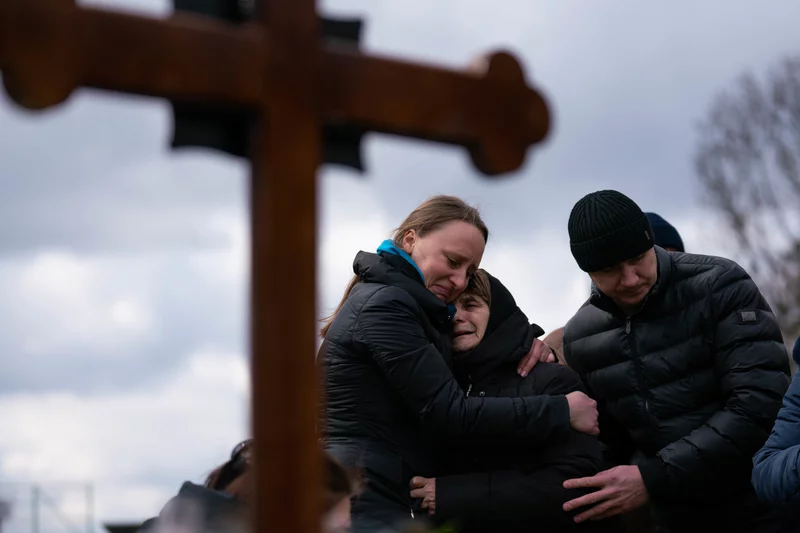
Featured image caption: The mother (center) of Ukrainian journalist-turned-soldier Viktor Dudar grieves at his grave as he’s laid to rest in Lviv in March of 2022, as some of the first dead soldiers’ bodies are returned home. Claire Harbage/NPR