
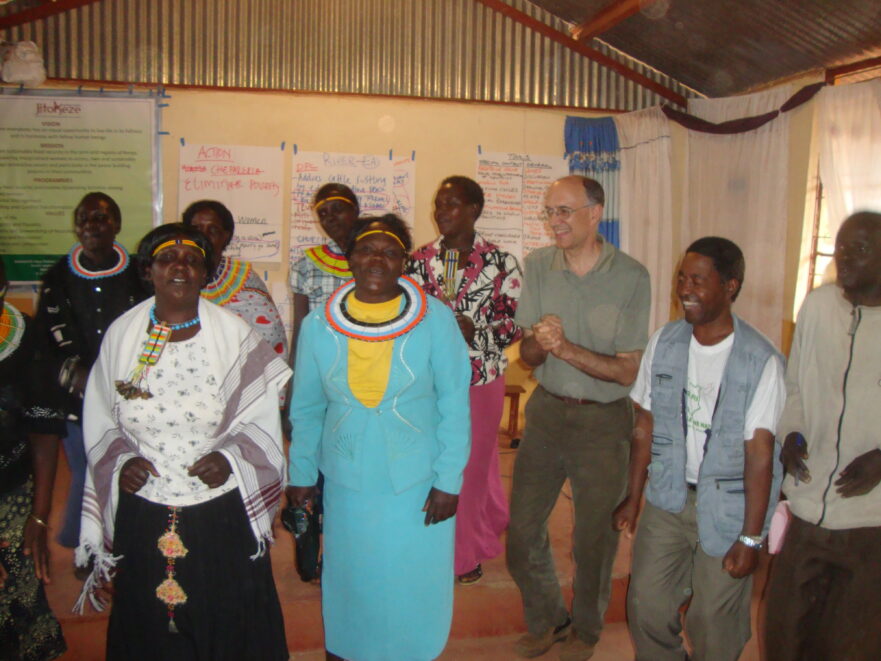
Reprinted with permission from Baptist News Global. This article explores the peacebuilding work of Dan and Sharon Buttry, whose framework informs the peacebuilding trainings facilitated by 21Wilberforce through partnerships with International Ministries trainers. These workshops equip church leaders across generations to articulate shared visions for peace and to work collaboratively to address division in their communities.
By Lou Ann Sabatier
In a world marked by war, political polarization, religious violence and collective trauma, the Christian call to peacemaking can sound either impossibly idealistic or dangerously naïve. For the Rev. Dr. Daniel L. Buttry and the Rev. Sharon Buttry, however, peacebuilding has never been an abstract ideal. It has been a lived vocation—rooted in Scripture, shaped by global experience, and sustained by a deep trust in the work of the Holy Spirit.
Both retired in 2020 after decades of service with International Ministries of the American Baptist Churches, but retirement has not quieted their witness. Instead, their work continues to ripple outward through communities, congregations, trainers, activists and faith leaders around the world who carry forward what the Buttrys describe not as a set of techniques, but as a way of being.
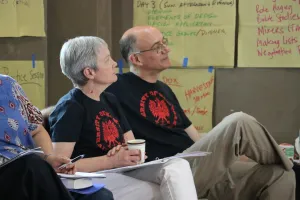
Dan and Sharon Buttry during a peacebuilding training session in the Philippines in 2016. Photo credit: Globalpeacewarriors.org
Through partnerships with International Ministries trainers, 21Wilberforce has facilitated peacebuilding workshops with senior church and young leaders internationally. Grounded in the work of Dan and Sharon Buttry, the training equips participants to name a shared vision for peace in their contexts and encourages collaboration among ministries and communities seeking to heal division.
For Dan Buttry, peacemaking is not an optional add-on to Christian discipleship. It is central to the nature of God and the mission of Christ.
“Peace is part of the very nature of God and God’s work,” he says, pointing to Ephesians 2 and its vision of reconciliation between God and humanity that necessarily leads to reconciliation among people. Jesus’ blessing—“Blessed are the peacemakers, for they shall be called the children of God”—is not metaphorical encouragement, Buttry insists, but a defining marker of Christian identity.
That conviction is reinforced by the biblical witness of Isaiah, who names the Messiah as the “Prince of Peace.” For Christians who claim allegiance to Christ, Buttry argues, following Jesus means taking seriously his nonviolent, reconciling way in the world.
This theological grounding also explains why the Buttrys have consistently engaged in interfaith peacebuilding, even in places where religion itself has been weaponized.
“We don’t show the peacemaking love of God if we’re focused on judgment or vengeance,” Dan says, pointing to Romans 12’s call to overcome evil with good. Religious violence, he notes, is one of the great evils of the modern world. Working for justice and peace alongside people of other faiths is not a dilution of Christian witness, but often a more faithful expression of it.
“God often surprises us,” he adds, “by doing something special and good through and with people outside our circle of religious identity.”
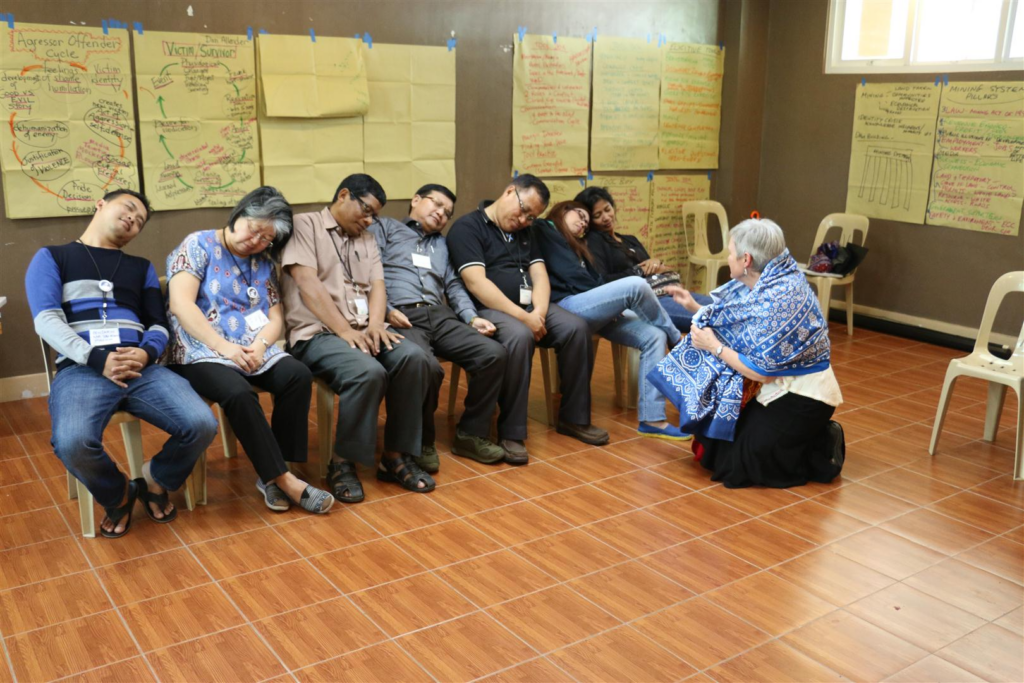
Sharon Buttry is acting out the story of Rizpah from 2 Samuel 21 in the Philippines. The Buttry’s wrote a book about that titled, Daughters of Rizpah: Nonviolence and the Transformation of Trauma. Photo credit: Globalpeacewarriors.org
From Invitation to Listening
Over the course of his career as Global Consultant for Peace and Justice, Dan Buttry traveled to nearly every region of the world, facilitating conflict transformation trainings and mediations from grassroots communities to academic institutions. His work took him deeply into places marked by armed conflict, including Myanmar and the border regions of northeast India.
Yet he never arrived as a self-appointed expert.
“I was always invited by someone local,” he explains—either an indigenous leader or a missionary already embedded in the context. Before any training or facilitation began, his first task was listening: hearing how local people understood the conflict, what efforts had already been tried, and what dynamics were shaping both violence and hope.
That posture of listening reflects a core principle of the Buttrys’ work: peace cannot be imported.
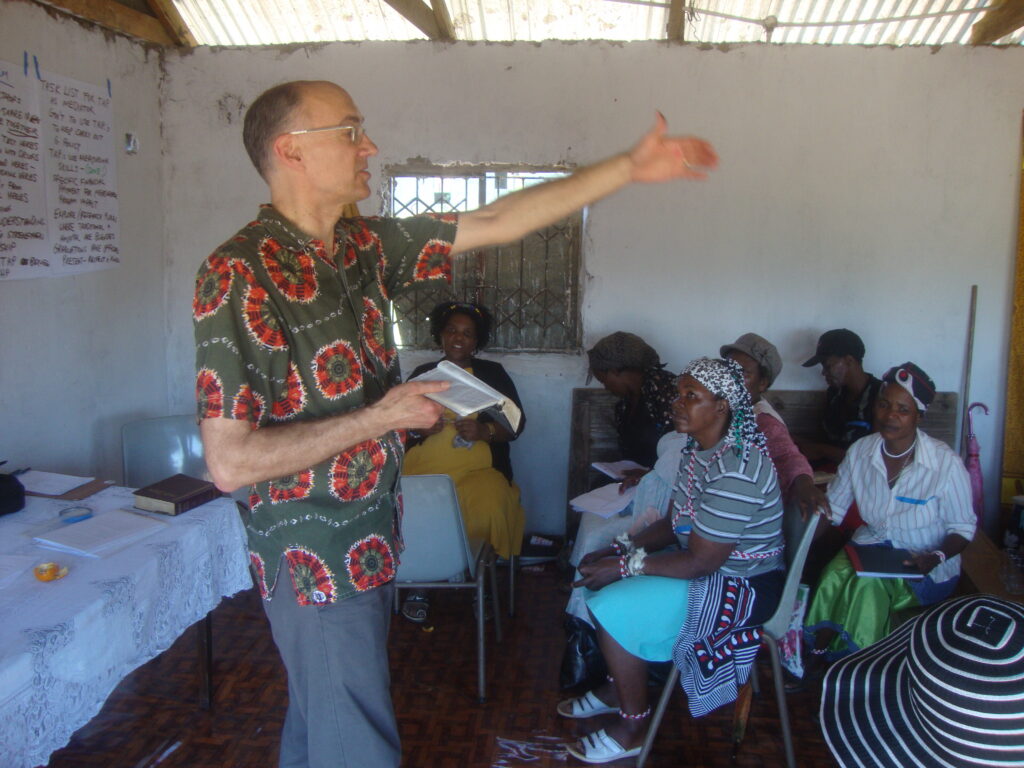
Dan Buttry leading a training in South Africa. Photo credit: Globalpeacewarriors.org
Context Over Models
One of Dan Buttry’s consistent critiques of international peace efforts is the tendency to export prefabricated solutions—sometimes baptized with biblical language—that collapse once outside facilitators leave.
“Conflicts need to be resolved by those within the conflict,” he says. Rather than teaching rigid models, the Buttrys introduce biblical stories, analytical tools and experiential exercises, then invite participants to ask their own questions within their own cultural, political and historical realities.
Their trainings rely heavily on experiential education, where facilitators act less as lecturers and more as guides—creating space for communities to wrestle with new possibilities themselves. Ideas that emerge from within a context, Dan says, are far more likely to endure.
Training That Multiplies
In the early decades of his ministry, Dan Buttry was often directly involved in mediation efforts, partnering with leaders such as Saboi Jum in Myanmar and Wati Aier in Nagaland. That chapter of his life is chronicled in his memoir, Peace Warrior.
A turning point came in 2009, when Buttry was diagnosed with prostate cancer—the same disease that had taken his father’s life at the same age. Confronted with mortality, he found himself returning to Psalm 90:12: “Teach us to number our days, that we may gain a heart of wisdom.”
That wisdom, he says, led him to focus on the next generation.
Instead of centering the work on himself, Buttry developed a 10-day Training of Conflict Transformation Trainers (TCTT), sometimes jokingly called “the grad school of the University of the Streets.” The goal was not simply to train peacebuilders, but to train trainers—leaders capable of multiplying the work in their own regions.
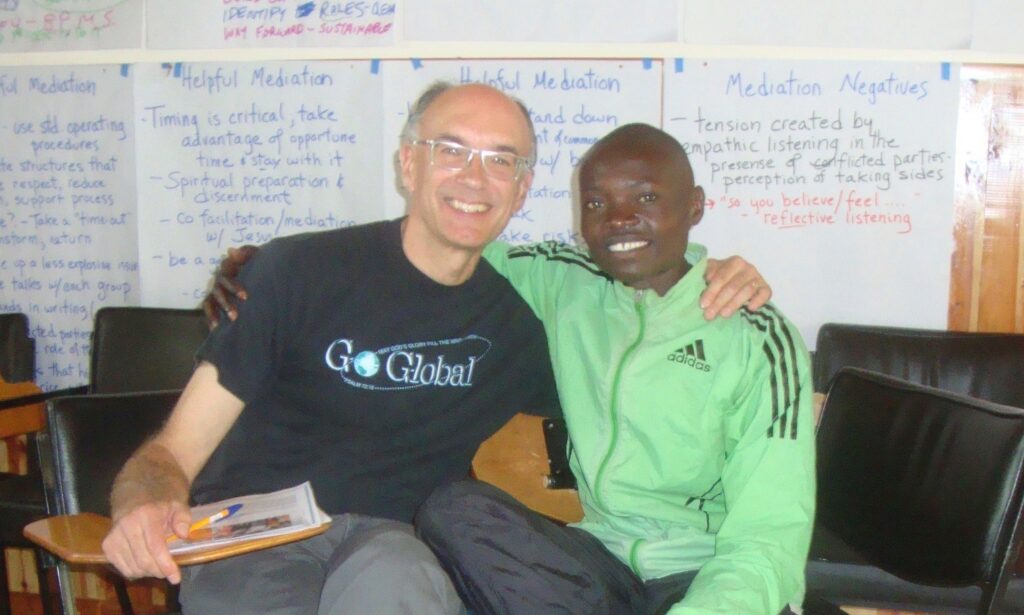
Dan Buttry mentors Boaz Keibarak from Kenya in peacebuilding in 2013. Photo credit: Globalpeacewarriors.org
Sharon Buttry played a crucial role in reinforcing that shift. After co-facilitating a historic TCTT in Kenya in 2013, Dan was invited to lead another in Nigeria. He asked Sharon to accompany him. She refused—and insisted he take one of the Kenyan trainees instead.
“She told me I needed to take Lance (Muteyo) with me,” Dan recalls. “I’m a bit slow to learn some lessons, but God always sends help along the way.”
The result has been a global network of second- and third-generation peacebuilders whose impact far exceeds what any one couple could have accomplished alone.
Inside Conflict Transformation Training
For participants unfamiliar with conflict transformation, the Buttrys’ trainings can be both disorienting and transformative. While there is a design framework, the facilitators remain attentive to what emerges in the group itself.
“We believe the Holy Spirit is our co-facilitator,” Dan says. Sharon notes that key moments cannot be scripted, and resistance often surfaces as participants prepare to return to volatile home contexts.
Rather than suppressing doubt, the Buttrys help participants name it—drawing attention to the courage and resilience they have already demonstrated. This “emergent design,” Dan explains, is part of the art of facilitation.
More than a toolbox, the trainings cultivate a way of being—a posture of leadership that trusts communities to do their own deep work. Dan often compares the role of a trainer to that of a midwife, helping to bring forth something new the Spirit is already stirring.
Stories That Heal and Inspire
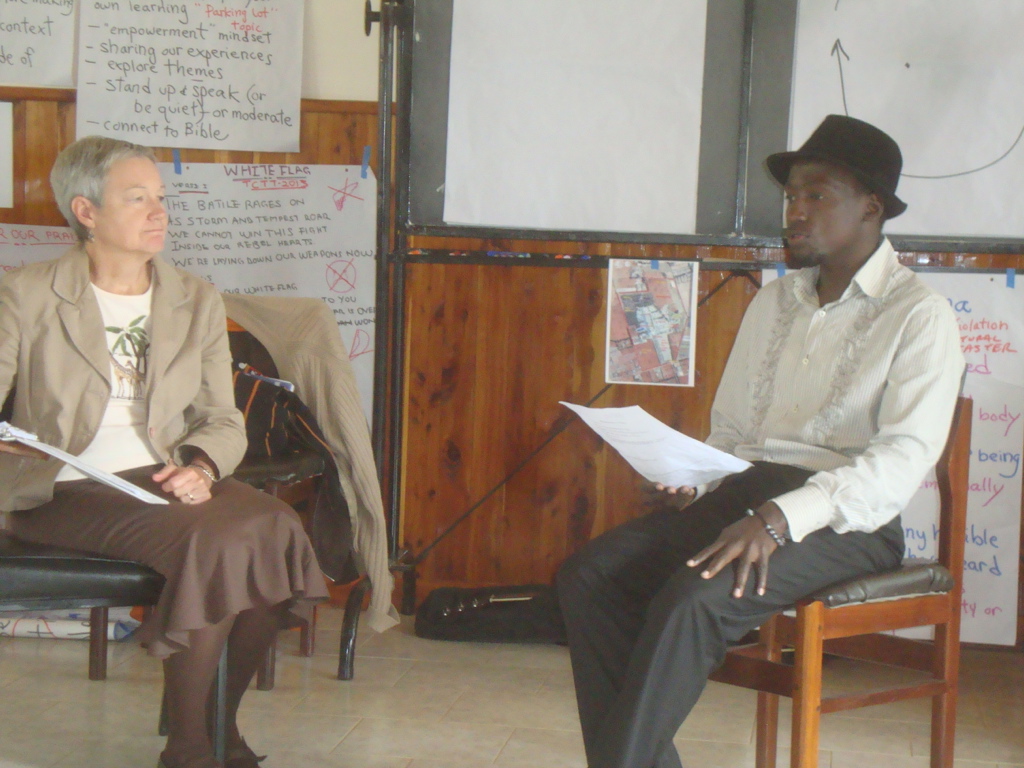
Sharon Buttry mentors Phililp Kakungul from Uganda in peacebuilding. Photo credit: Globalpeacewarriors.org
Storytelling lies at the heart of the Buttrys’ approach. Biblically, they favor narrative over abstract propositions, inviting participants to enter the text with their whole selves. That elicitive approach, Dan says, consistently surfaces insights he and Sharon could never have predicted.
Equally important are the stories of participants themselves.
“Sometimes we’re humble about what we’ve lived through,” Dan notes. “But when we share our stories, the wisdom that’s emerged can be seen for the gift it is.”
Through books, trainings and the Global Peace Warriors website, the Buttrys intentionally lift up “ordinary” peacemakers—people whose creative, courageous actions open new possibilities for others. The implicit question, Dan says, is always the same: “If they can do that, why can’t I?”
Signs of Real Change
Measuring success in peacebuilding is often difficult, especially when the most meaningful outcome is that “nothing happened.”
Still, the Buttrys point to tangible indicators. Hope begins to take root. Communities start living into the future they imagine. Knowledge and skills multiply across generations, even among children trained in nonviolent tools that reshape families, schools and churches.
In Kenya, graduates of the TCTT helped prevent post-election violence by organizing across ethnic lines—facilitating joint trainings, peace marches and public rallies. When the next election arrived, widespread violence did not.
“That’s success,” Dan says simply.
Sharon points to her work in Hamtramck, Michigan, where restorative practices were implemented across the school district. Teachers, social workers and students learned peer mediation, and Sharon witnessed young people defusing conflicts even outside school settings.
Trauma, Power and the Margins
One of the most distinctive contributions of the Buttrys’ work is their insistence that trauma is not only personal, but communal and political. Their recent book, Daughters of Rizpah: Nonviolence and the Transformation of Trauma, explores this theme through Scripture and global case studies.
Drawing on the story of Rizpah in 2 Samuel 21, the book highlights how nonviolent action by traumatized individuals—often women on the margins—can catalyze profound change. From South Asia to Africa, the Buttrys have seen women disrupt entrenched power structures with moral clarity, strategic courage and deeply contextual action.
Training around power dynamics, including mainstream-and-margin analysis, helps faith leaders understand how to act effectively—and safely—within oppressive systems. Because resistance can be dangerous, the Buttrys emphasize building allies, networks and spiritual resilience.
Daily prayer, worship and Scripture are not add-ons to their trainings, but essential grounding. “Peacebuilding is a practice,” Dan says, “but it’s also who we are becoming in Christ—people of shalom.”
Looking Ahead
Both Dan and Sharon are candid about the mixed role religious institutions play in peacebuilding. Denominations and agencies can provide crucial support, funding and legitimacy. Yet many peacebuilders, especially those in minority contexts, receive little institutional backing because their work is deemed too controversial.
Those courageous leaders, Dan says, are among his heroes.
For the next generation of peacebuilders, the Buttrys offer simple but demanding wisdom: do the hard work of preparation, but stay open to the Spirit.
“Jesus and the Holy Spirit are involved in our peacemaking efforts,” Dan says. “They see beyond what we can see. Learn to discern what God is doing—in you and in the group—and be ready to follow.”
In a fractured world hungry for hope, the Buttrys’ lifework stands as a testament to the power of faithful presence, patient listening and courageous love—quietly, persistently building peace where it seems least possible.
Lou Ann Sabatier serves as Director of Communications for 21Wilberforce
February 5, 2026