By Wissam al-Saliby
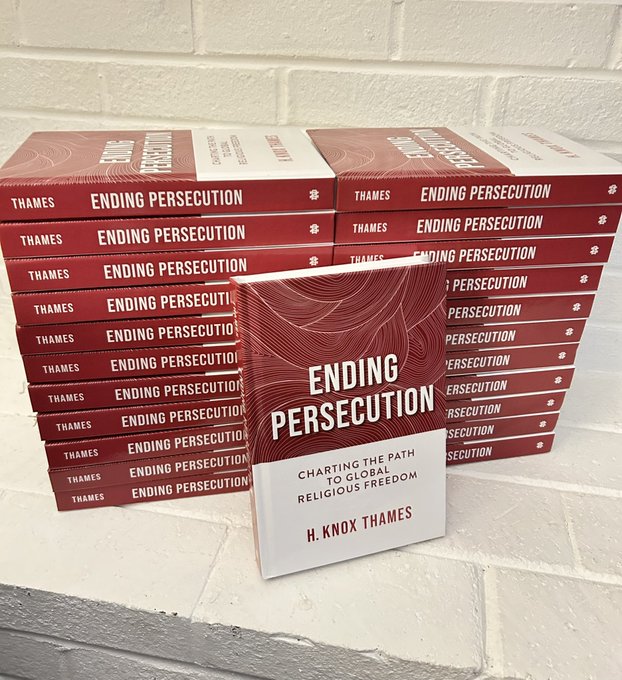
We are pleased to share the following review by our President, Wissam al-Saliby, originally published in the International Journal for Religious Freedom, Vol. 18, No. 2 (2025). In this thoughtful and timely engagement with Ending Persecution: Charting the Path to Global Religious Freedom by Knox Thames, al-Saliby reflects on the book’s call for principled leadership and renewed commitment to advancing freedom of religion or belief worldwide. Reprinted here with permission, the review explores both the enduring relevance of Thames’ proposals and the pressing challenges facing international religious freedom advocacy today.
Ending Persecution illuminates the threats to religious freedom, proposes innovative strategies for response, and challenges the United States to reaffirm its commitment to combating persecution. Knox Thames frames the stakes with a critical question: “The defining question of the twenty-first century will be whether we can defeat the age-old scourge of religious persecution. How can we best help those suffering for their beliefs? What should we do?”
The book intertwines Thames’ personal experiences as a US State Department diplomat and US Commission on International Religious Freedom commissioner, offering insights into both the theory and practice of international religious freedom.
Let’s begin with a pressing question: In the context of the second Trump administration, does Thames’ book belong to a bygone era?
Thames champions a principled, consequential US foreign policy and an outward-looking American polity. He calls for stronger bilateral and multilateral engagement by the United States, and he suggests elevating international religious freedom as a foreign policy priority, as well as institutionally within the State Department (306).
The opposite is happening. The State Department has been downsized and is now staffed by leadership skeptical of multilateralism. Human rights, development, and humanitarian aid have been deprioritized within the institutional framework. The current administration’s foreign policy is characterized by a transactional approach, with America increasingly looking inward. Furthermore, the US has withdrawn from the United Nations Human Rights Council, the World Health Organization, and the Universal Periodic Review – the UN’s human rights monitoring process. It has shut down many of USAID’s lifesaving programs. Thames rightly calls for the credible and consequential use of sanctions as well as accountability for genocide, including through the International Criminal Court (ICC). Yet the US has continued to supply weapons to Israel as it conducts a devastating war and imposes starvation, resulting in the death of close to 70,000 (possibly 100,000 deaths according to some studies) Palestinians in Gaza. At the same time, the United States has imposed sanctions on the ICC in response to charges against Israeli leaders for crimes against humanity. Refugee resettlement in the United States, another policy for which Thames advocates, has come to a screeching halt in recent months.
As I read the final chapter, “New Approaches for New Results,” I couldn’t help but remember the Arab proverb, “To whom are you reading your psalms, David?” Is anyone listening? The current political climate in Washington, DC, is anything but favorable to the weighty reforms Thames proposes.
However, given the turbulence of the current political moment, Thames may have emerged as a much-needed prophet, albeit unintentionally.
Thames’ personal journey is unique, set against a geopolitical backdrop that may, unfortunately, be singular in history. Thames played a pivotal role in initiating the first International Religious Freedom Ministerial, and his influence within US foreign policy and at the United Nations has been significant. Religious freedom advocates, civil society leaders, aspiring civil servants, and educational institutions will find in Thames’ book and journey invaluable information and insights that complement their knowledge and enhance their strategies in support of religious freedom for all.
Notably, he adopts a principled approach to religious freedom advocacy, critiquing countries based on facts – including US allies such as India, Pakistan and Egypt – rather than limiting his criticism to the usual targets of US foreign policy such as China, Iran, and North Korea. His chapter “Tyrannical Democracy” is a refreshing read and serves as a warning of the direction any democracy can take if left unchecked. And he emphasizes repeatedly some of the difficulties and failures the United States has experienced in upholding standards of religious freedom and human rights. Thames does omit what I considered the largest recent US foreign-policy failure, one that decimated Middle Eastern Christians and laid the foundations for ISIS: the 2003 war on Iraq.
Throughout the book, Thames provides examples of successful advocacy for religious freedom, illustrating how governments have yielded to such pressure, at least temporarily, and how leadership and commitment can effect change. These examples should inspire all advocates for religious freedom, who often wait years to see the fruits of their labor.
The book offers a more practical approach to understanding the full scope of the right to freedom of religion or belief than a traditional scholarly textbook, fea-turing real-world examples of advocacy for the right to worship, the registration of places of worship, freedom from arbitrary detention, and the right to convert.
Thames explains the advocacy tools at our disposal and how to utilize them, and he also highlights the international platforms and forums with which we must engage. The book further emphasizes the efforts of scholars, diplomats, politicians, religious leaders, civil servants, and civil society leaders who have tirelessly supported religious freedom, many of whom I have had the privilege to meet and work with. It was most encouraging to read of the courageous efforts of indigenous leaders from minority religious groups (including Shahbaz Bhatti from Pakistan, and Haider Elias and Ashur Eskrya from Iraq) and of secular civil society groups (such as EIPR in Egypt) whose work Thames supported.
At the heart of Ending Persecution lies its most important lesson: the need for quality leadership. Knox Thames exemplifies principled ethical leadership committed to the dignity and rights of all individuals. His book calls every person of faith to recognize both the opportunities available and the challenges that can be overcome. Their leadership can effect real change in support of religious freedom for everyone. Despite the new direction the United States is taking, diplomacy, human connection, friendship, and principles can still make a meaningful difference.
Wissam al-Saliby, President, 21Wilberforce
Ending Persecution: Charting the Path to Global Religious Freedom by Knox Thames, South Bend, Ind.: University of Notre Dame Press 2024, 400 pp., ISBN 978-0268208677, $45 US
February 19, 2026